
Southeast Asia Export Opportunities 2026: Ultimate Guide for Chinese Exporters
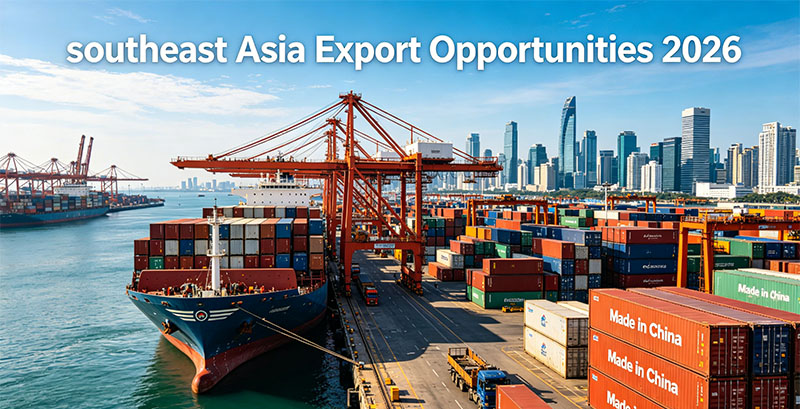
Are you looking for stable, high-growth overseas markets to offset saturated European and American markets? In 2026, Southeast Asia stands as the most reliable export hotspot for Chinese manufacturers, suppliers, and trading companies. Benefiting from RCEP full implementation, the China-ASEAN Free Trade Area 3.0 upgrade, global China+1 industrial transfer, and booming young consumer demand, Southeast Asia has become a core incremental market for Chinese exports.
Unlike the fiercely competitive, tariff-barrier-heavy Western markets, Southeast Asia offers lower entry thresholds, zero-tariff preferences, rising local demand, and sustainable profit margins. This SEO-optimized guide breaks down the latest Southeast Asia export opportunities, top target countries, high-demand product categories, potential risks, and actionable export strategies for 2026.
1. Core Macro Advantages of Southeast Asia Export in 2026
Southeast Asia’s export boom is not temporary market volatility but driven by four long-term institutional, economic, demographic and industrial dividends, creating lasting opportunities for Chinese exporters.
1.1 Institutional Dividends: RCEP & CAFTA 3.0 Reduce Export Costs
The full implementation of RCEP rules of origin and the official launch of China-ASEAN FTA 3.0 (2026) have completely optimized regional trade efficiency. Products with over 40% regional value content qualify for zero tariffs, greatly cutting tariff costs for Chinese intermediate goods and finished products exported to ASEAN.
Meanwhile, upgraded customs clearance policies enable clearance of perishable and industrial goods within 6 hours, reducing overall logistics costs by 15%–25%. The new FTA 3.0 rules further cover digital trade, green economy and SME trade facilitation, bringing more flexible export scenarios for Chinese enterprises..
1.2 Demographic & Economic Dividends: Continuous Domestic Demand Growth
Southeast Asia has a total population of 680 million with a median age under 30, forming a huge young consumer group. In 2026, ASEAN maintains a steady GDP growth rate of 4.5%–4.6%, ranking among the top global emerging economic regions.
Rising middle-class groups and accelerated local industrial upgrading have driven annual import demand growth of 8%–12%. E-commerce penetration in Indonesia and Vietnam grows by over 30% yearly, bringing huge incremental demand for consumer goods, electronic accessories and home products.
1.3 Industrial Transfer Dividend: China+1 Strategy Boosts Intermediate Goods Exports
Affected by Western trade barriers and global supply chain optimization, the China+1 industrial layout has accelerated. Vietnam, Thailand and Malaysia have become emerging manufacturing hubs for electronics, textiles and new energy.
Local supporting industries in Southeast Asia are incomplete, forming a strong reliance on Chinese core accessories, automated equipment, raw materials and industrial supplies. At present, intermediate goods account for over 60% of China’s exports to ASEAN, becoming the fastest-growing export segment.
1.4 Market Competition Dividend: Lower Saturation Than European & US Markets
European and American markets face fierce price wars, frequent anti-dumping investigations and shrinking orders. In contrast, Southeast Asian markets feature friendly trade relations with China, stable tariff policies, unsaturated market demand and lower industry involution, enabling Chinese exporters to maintain better profit margins.
2. Top 6 Southeast Asian Countries for Export in 2026 (Differentiated Opportunities)
Each Southeast Asian country has distinct industrial positioning and demand characteristics. Targeted market selection is the key to improving export conversion rate and avoiding blind investment.
2.1 Vietnam: The No.1 Core Export Market
Market Positioning: Global manufacturing base for electronics, textiles and hardware, the most export-oriented ASEAN country.
High-Demand Products: Electronic components (PCB, chips, display screens), textile machinery & fabrics, construction machinery, building materials and industrial accessories.
Advantages: Preferential tax policies, mature port logistics, CPTPP and EVFTA tariff preferences, huge demand for supporting manufacturing materials.
Risks to Avoid: Anti-dumping duties on steel and textile products, seasonal labor shortages, need to optimize product structure and export semi-finished goods to avoid barriers.
2.2 Indonesia: Largest Domestic Demand Market
Market Positioning: Dominated by domestic consumption and resource deep processing, with a population of 280 million (the largest in Southeast Asia).
High-Demand Products: Home appliances, furniture, daily hardware, new energy battery equipment, construction materials and agricultural machinery.
Key Policy Update 2026: Indonesia bans imports of 12 categories of finished consumer goods, greatly boosting export opportunities for parts, semi-finished products and production equipment.
Mandatory Requirement: Halal certification for daily consumer goods to meet local religious market standards.
2.3 Thailand: Southeast Asia’s New Energy & Automobile Hub
Market Positioning: Traditional automobile manufacturing base and emerging EV industrial center in Southeast Asia.
High-Demand Products: EV auto parts, new energy charging piles, photovoltaic modules & inverters, CNC machine tools and agricultural machinery.
Industry Trend: Thailand’s 2026 auto policy requires "1 imported EV corresponds to 2 locally manufactured EVs". Chinese new energy brands dominate the local market, driving explosive demand for supporting auto parts.
2.4 Malaysia: High-End Electronic & Green Tech Market
Market Positioning: High-end manufacturing hub for semiconductors, photovoltaics and fine chemicals.
High-Demand Products: Semiconductor components, photovoltaic accessories, precision instruments, medical devices and industrial chemical materials.
Mandatory Requirement: SIRIM certification is compulsory for most electronic and electrical products, with stricter inspection standards in 2026.
2.5 Philippines: Rigid Demand for Civilian Consumption & Infrastructure
Market Positioning: Consumer-oriented market with continuous infrastructure investment.
High-Demand Products: Small home appliances, daily hardware, bathroom accessories, building materials and food processing equipment. Local consumers prioritize cost-effectiveness and durability, fitting the advantages of Chinese manufacturing.
2.6 Singapore: High-End Re-Export & Premium Market
Market Positioning: Southeast Asian regional trade headquarters, focusing on high-end manufacturing and re-export trade.
High-Demand Products: Precision instruments, integrated circuits, pharmaceutical materials, high-end chemical products and premium consumer goods. Suitable for high-value, high-quality Chinese manufacturing products.
3. 6 High-Growth Export Product Categories (2026 Golden Tracks)
Based on ASEAN industrial upgrading and consumer demand changes, the following six product categories have the highest export growth and profit space for Chinese enterprises.
3.1 Electromechanical & Electronic Products (45%+ of Total Exports)
Electronic components (capacitors, resistors, PCB circuit boards), automated production lines, packaging machinery and 3C accessories maintain stable high demand. As local manufacturing expands, the demand for Chinese high-cost-performance industrial equipment continues to rise.
3.2 New Energy Products (Fastest Growing Segment)
Southeast Asia’s demand for photovoltaic power generation, energy storage and new energy vehicles is exploding. Exports of Chinese photovoltaic modules and inverters increased by over 50% in 2025. Chinese EV brands occupy 80% of Thailand’s new energy vehicle market, driving supporting demand for battery parts and charging equipment.
3.3 Automobile & EV Parts
Supported by Thailand and Indonesia’s new energy industrial policies, engine parts, chassis accessories and EV three-electric system parts have become core hot-selling products. Chinese auto parts have significant cost and technical advantages in the Southeast Asian market.
3.4 Construction Materials & Hardware
Large-scale infrastructure construction in Vietnam, Indonesia and Philippines drives steady demand for steel profiles, glass, ceramic tiles, bathroom hardware and aluminum materials. Small hardware tools are also mainstream cross-border e-commerce bestsellers.
3.5 Daily Consumer Goods & Home Products
Small home appliances, household furnishings, beauty tools, maternal and infant products adapt to the young consumer group in Southeast Asia. Localized optimization (Halal adaptation, voltage conversion, language customization) can significantly improve sales conversion.
3.6 Textile Intermediate Materials
Vietnam, Cambodia and Indonesia are global textile manufacturing bases, with strong reliance on Chinese yarn, fabrics and textile machinery. To avoid anti-dumping risks on finished garments, exporting textile intermediates is the safest and most profitable mode.
4. Key Export Risks & Practical Solutions (2026 Updated)
While seizing opportunities, Chinese exporters need to avoid regional trade and compliance risks to ensure stable order delivery.
4.1 Trade Barrier Risks
Indonesia’s finished product import ban, Vietnam’s anti-dumping duties on steel and textiles, and Malaysia’s SIRIM certification restrictions are common barriers. Solutions: Export semi-finished products and production equipment, apply RCEP certificate of origin for tariff reduction, and carry out re-export through third countries such as Cambodia and Laos.
4.2 Rising Compliance Costs
Mandatory certifications including Halal, SIRIM, TISI and local VAT declaration increase operating costs. Solutions: Complete product certification in advance, cooperate with local compliant agents, and optimize tariff planning via RCEP rules.
4.3 Unbalanced Logistics & Supply Chain
Singapore, Vietnam and Thailand have perfect logistics, while Cambodia and Laos have weak infrastructure. Solutions: Set up overseas warehouses in core ports (Ho Chi Minh, Bangkok, Jakarta) to realize centralized warehousing and local distribution.
4.4 Regional Policy Fluctuations
Elections and policy adjustments in individual Southeast Asian countries bring uncertain risks. Solutions: Adopt a "1 main + 1 auxiliary" market layout to avoid over-reliance on a single country and disperse operational risks.
5. Practical Export Strategies for Chinese Exporters in 2026.
5.1 Market Layout Strategy
Prioritize Vietnam and Indonesia as core offensive markets with the largest demand increment; take Thailand and Malaysia as high-end auxiliary markets. Avoid full-market expansion and focus on deep cultivation of 1–2 target countries to improve brand awareness and customer stickiness.
5.2 Product Optimization Strategy
Shift from finished product export to intermediate goods, production equipment and overall solutions to evade trade barriers. Optimize products locally: adapt to local voltage, plug specifications, language and religious needs, and highlight cost-effectiveness and durability advantages.
5.3 Channel Operation Strategy
Make full use of RCEP certificate of origin to reduce tariff costs by 10%–25%. Combine cross-border e-commerce, independent websites and local social media marketing (Facebook, TikTok, Zalo). Adopt the "small-batch trial order + large-batch stable cooperation" model to reduce market trial costs. Cooperate with local agents or establish joint ventures to reduce compliance and channel risks.
6. Frequently Asked Questions (FAQ)
Q1: Which Southeast Asian country is the best for Chinese exporters in 2026?
A: Vietnam is the best choice for industrial supporting products and finished consumer goods; Indonesia is suitable for bulk daily necessities and new energy equipment; Thailand and Malaysia are preferred for high-end electronics and EV parts.
Q2: What is the biggest advantage of exporting to Southeast Asia in 2026?
A: The superposition of RCEP and CAFTA 3.0 institutional dividends ensures stable zero-tariff preferences. Meanwhile, the young population and industrial transfer bring continuous incremental demand, with far lower competition and risks than European and American markets.
Q3: What products are prohibited or restricted from exporting to Southeast Asia?
A: Indonesia bans many finished consumer goods imports; Vietnam has anti-dumping restrictions on steel and textiles; electronic products must pass mandatory certification. It is recommended to export semi-finished products and supporting equipment to avoid restrictions.
Q4: How can Chinese exporters reduce Southeast Asia export costs?
A: Apply for RCEP origin certification for tariff reduction, set up overseas warehouses to cut logistics costs, cooperate with local formal agents to reduce compliance costs, and optimize product localization to improve pass rate and repurchase rate.
7. Final Conclusion
In 2026, Southeast Asia is undoubtedly the most deterministic high-growth export market for Chinese enterprises. Driven by institutional dividends, industrial transfer and young consumer demand, the market maintains stable growth momentum. Electromechanical equipment, new energy products, auto parts, building materials and daily consumer goods are the core golden export tracks.
For Chinese exporters, abandoning blind expansion of saturated Western markets and focusing on targeted layout of Southeast Asian sub-segment tracks, matching local demand and complying with regional policies will help seize the first-mover advantage in the emerging market and achieve sustained order growth.
Related News
- CNC Machining Castings: Machining Allowance, Datums and Defects
- CCMS Industrial Delivers Precision CNC Parts for Advanced Automation Equipment Applications
- CNC Machining Design Guide: Make Parts Easier to Quote and Produce
- How to Select the Right Centerless Grinder for Your Precision Machining Shop
- How High-Torque Gearboxes Improve Uptime for Excavator and Drilling Fleet Operations
- CNC Machining Surface Finishes: How to Specify Texture and Treatment
Leave me a message
New Products