
How to Choose the Right Centerless Grinder for Your Production Line
Introduction
Selecting the right centerless grinder is one of the most critical decisions for any manufacturing production line. Unlike conventional grinding machines that require workpiece center holes and rigid clamping, a centerless grinder processes cylindrical parts without fixing the workpiece at both ends. It delivers continuous feeding, high output, and consistent surface finish, making it indispensable for mass production in automotive, hardware, bearing, and precision machinery industries.
However, many factory managers and procurement engineers face the same challenge: picking an unsuitable centerless grinder leads to low production efficiency, unstable workpiece tolerance, frequent downtime, and unnecessary cost waste. Understanding the core selection criteria will help you match the perfect centerless grinder to your production scale, workpiece type, and precision requirements. This guide walks you through every key factor to consider when choosing a centerless grinder for your production line.
1. Confirm Your Workpiece Specifications First
Before comparing any centerless grinder models, you must clarify the basic parameters of the parts you need to grind. This is the foundation of all selection work.
First, define the workpiece diameter and length. Different centerless grinders are designed with different machining ranges. Small precision pins, bearing rollers, and thin shaft parts require a small and medium-sized centerless grinder, while large hydraulic shafts, motor shafts, and heavy cylindrical workpieces need a heavy-duty centerless grinder with a larger grinding range. Choosing a machine beyond its machining limit will cause vibration, out-of-tolerance size, and shortened machine service life.
Second, check the workpiece material. Common materials include carbon steel, alloy steel, stainless steel, copper, aluminum, and hardened steel. Hardened and high-alloy materials require a centerless grinder with stronger spindle rigidity and high-quality grinding wheels, while soft metal parts need optimized feeding speed and wheel matching to avoid surface scratches.
Third, clarify the machining purpose. Whether you need through-feed grinding for full-length outer circle finishing or in-feed grinding for shoulder, step, and partial outer circle processing directly determines the structural configuration you need in a centerless grinder.
2. Match Precision Requirements With Machine Grade
Precision is the core advantage of a qualified centerless grinder, and different production lines have completely different tolerance standards.
For ordinary hardware parts, standard-grade centerless grinders can meet dimensional tolerance and ordinary surface roughness demands with stable daily mass production. For bearing parts, medical equipment shafts, and aerospace precision components, you need a high-precision centerless grinder that can maintain micron-level tolerance. Pay attention to the spindle runout, bed structural stability, and feeding accuracy of the centerless grinder.
CNC centerless grinders perform far better than manual and semi-automatic models in long-term precision retention. If your production line requires long-time continuous operation and consistent product accuracy without manual adjustment, upgrading to a CNC centerless grinder is a cost-effective long-term choice. Avoid blindly choosing low-cost standard machines if your products have strict precision standards, as rework and defective rates will far exceed the initial savings.
3. Consider Production Capacity and Automation Level
Your daily output demand directly decides the type and automation configuration of the centerless grinder.
For small-batch, intermittent production, a semi-automatic centerless grinder is sufficient, with lower investment and flexible operation. For medium and large batch mass production lines, a fully automatic centerless grinder with automatic feeding and unloading mechanisms is essential. It reduces manual intervention, lowers labor costs, and keeps production speed stable.
Modern production lines are pursuing unmanned and intelligent processing. When choosing a centerless grinder, you can check whether it supports docking with automatic conveyor lines, sorting machines, and assembly lines. A highly automated centerless grinder can perfectly integrate into your entire production workflow and improve overall line efficiency.
4. Evaluate Machine Structure and Durability
A centerless grinder is a long-term investment for a production line, so structural rigidity and durability cannot be ignored.
The bed material is key. High-quality centerless grinders adopt high-strength cast iron beds, which have good shock absorption and deformation resistance, ensuring stable operation for years. Poorly assembled machines with thin beds will vibrate severely during high-speed grinding, resulting in poor workpiece roundness and surface finish.
In addition, pay attention to the grinding wheel, regulating wheel, bearing system, and transmission parts. Well-known brand accessories and standardized assembly processes greatly reduce failure rates and maintenance frequency. A durable centerless grinder minimizes downtime and ensures the continuity of your production line.
5. Choose Between Manual, Semi-Automatic and CNC Type
It is necessary to select the control mode according to your technical team and production flexibility.
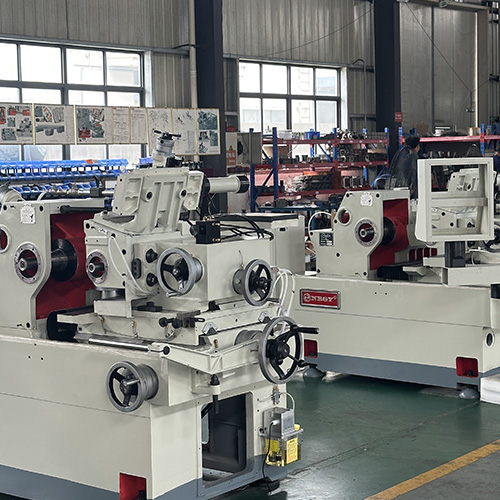
Manual centerless grinder is easy to operate, low in price, suitable for simple parts processing and small factories with low update frequency of product models.
Semi-automatic centerless grinder balances cost and efficiency, suitable for most conventional cylindrical part mass production, and is the mainstream choice for many medium-sized production lines.
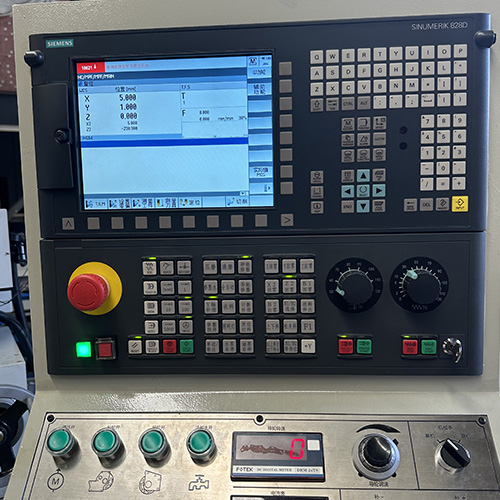
CNC centerless grinder supports one-key parameter setting, automatic compensation, and multi-process switching. It is suitable for factories with frequent product model changes, high precision requirements, and long-term continuous production. Although the initial investment is higher, it saves labor, reduces debugging time, and stabilizes product yield.
6. After-Sales Service and Technical Support
Many buyers only focus on machine price and parameters but ignore after-sales service, which brings huge hidden troubles to the production line.
A reliable centerless grinder supplier should provide professional installation and commissioning, operator training, timely spare parts supply, and long-term technical support. Once the machine breaks down, slow after-sales response will directly stop the entire production line and cause economic losses.
It is recommended to choose manufacturers with mature export experience and complete after-sales systems. They can not only provide standard centerless grinder models but also support customized configuration according to special production line needs.
7. Budget and Long-Term Return on Investment
Price is always an important factor in equipment procurement, but you should not only compare unit price.
Low-priced inferior centerless grinders have high defective rates, frequent maintenance, and short service life, with a very high comprehensive use cost. Moderately priced high-quality standard models and CNC models have stable performance, low failure rates, and long service life, bringing stable long-term returns to the production line.
Calculate the comprehensive benefit: production efficiency, yield rate, labor cost, and maintenance cost, instead of only focusing on the initial purchase price. This is the correct way to select a centerless grinder for long-term production line operation.
Conclusion
Choosing the right centerless grinder for your production line does not rely on blind selection or simply comparing prices. It needs comprehensive consideration of workpiece specifications, precision standards, production capacity, automation demand, machine structure, and after-sales support.
By clarifying your own processing needs first, matching the appropriate machine type and configuration, you can avoid unnecessary investment waste, improve production line efficiency, stabilize product quality, and create greater profit margins for your manufacturing business. If you are looking for a reliable centerless grinder matched with your production line, you can consult a professional manufacturer to get customized selection suggestions and technical parameters.
Related News
- CNC Machining Castings: Machining Allowance, Datums and Defects
- CCMS Industrial Delivers Precision CNC Parts for Advanced Automation Equipment Applications
- CNC Machining Design Guide: Make Parts Easier to Quote and Produce
- How to Select the Right Centerless Grinder for Your Precision Machining Shop
- How High-Torque Gearboxes Improve Uptime for Excavator and Drilling Fleet Operations
- CNC Machining Surface Finishes: How to Specify Texture and Treatment
Leave me a message